You post on LinkedIn three times a week. You share insights. You comment on other people’s content. You show up.
But the inquiries don’t come.
When you do reach out to potential clients, the response rate is low. The people who engage with your content rarely convert. You’re visible, but not in demand.
The problem isn’t your expertise. It’s not your consistency. The problem is simpler and more strategic: you’re targeting the wrong people.

Most experts make one of two mistakes.
Some chase the small group of buyers who are ready to purchase right now. They send cold messages. They pitch hard. They compete with dozens of other experts for the same narrow pool of clients who have already made up their minds.
Others create content for people who aren’t even thinking about buying. They post generic advice that gets likes but no leads. They attract attention from audiences who will never hire them.
Both approaches waste time. Both ignore a basic truth about how people buy: readiness matters more than visibility.
This is what happens when you don’t understand the buyer’s pyramid.
The buyer’s pyramid is a framework that shows how audiences are distributed across five readiness levels. It explains why cold outreach fails, why most content doesn’t convert, and where the real strategic opportunity sits.
Most experts have never heard of it. That’s why their personal brands don’t work.
This article fixes that. You’ll learn what the buyer’s pyramid is, why most experts target the wrong segments, and how to position yourself so warm, qualified buyers come to you instead.
The Framework Most Experts Have Never Heard Of
There’s a reason your personal brand feels like effort without results.
You’re not lazy. You’re not bad at marketing. You just don’t know about the buyer’s pyramid.
The buyer’s pyramid is a framework that shows how any market divides into five readiness levels. It maps where people sit based on how close they are to making a purchase.
Here’s what it looks like:
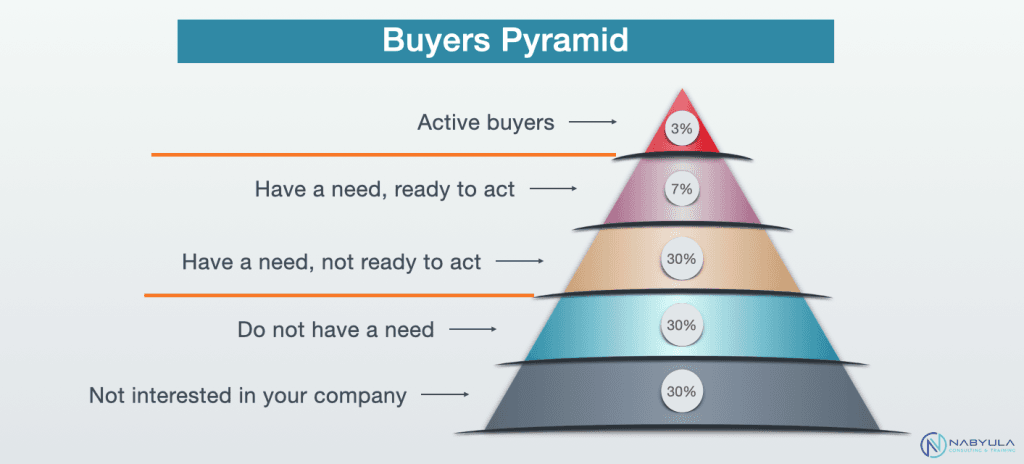
3% — Buying now
These people are actively searching for someone to hire. They’re comparing options. They’re ready to buy this week.
7% — Open to buying
These people know they need help. They’re not searching yet, but they’re thinking about it. They’re open to the right conversation.
30% — Not thinking about it
These people have the problem you solve, but they’re not focused on it right now. They’re busy. They’ll deal with it later.
30% — Don’t think they’re interested
These people don’t see the value in what you offer. They think they can handle it themselves or they don’t believe the problem is worth solving.
30% — Know they aren’t interested
These people are certain they don’t need what you do. Nothing you say will change that.
This pyramid explains something most experts miss: buyer readiness is unevenly distributed.
Only 10% of your market is ready to buy or thinking about buying. The other 90% either doesn’t care or isn’t there yet.
Most personal branding strategies ignore this. They treat all attention as equal. They assume visibility leads to demand.
It doesn’t.
If you don’t know where people sit in the pyramid, you waste time speaking to audiences who will never hire you. You compete for the wrong 3%. You create content for people who aren’t listening.
The buyer’s pyramid fixes that. It shows you who to speak to, what to say, and when positioning matters more than pitching.
The Two Mistakes Most Experts Make
Most experts don’t know the buyer’s pyramid exists. That ignorance creates two predictable mistakes.
Both waste time. Both kill conversion. Both explain why your personal brand attracts attention but not clients.
Mistake 1: Fighting Over the 3%
The first mistake is chasing people who are ready to buy right now.
This is the cold outreach trap.
You see someone who fits your ideal client profile. You send a message. You pitch your service. You explain how you can help.
They ignore you. Or they respond politely and go silent. Or they say they’re already working with someone.
Here’s why this fails: you’re competing with everyone else who knows how to use LinkedIn search filters.
The 3% who are buying now have already started their evaluation. They’re comparing options. They’re getting messages from ten other experts who do what you do. They’ve probably already shortlisted someone.
You’re late. You’re one of many. You have no trust advantage.
Cold outreach to ready buyers is a volume game. You need to contact hundreds of people to land a handful of conversations. The conversion rate is low. The effort is high. The positioning is weak.
You’re fighting over the smallest, most saturated segment of the market.
This is not strategy. This is desperation dressed up as hustle.
Creating Content for the Bottom 60%
The second mistake is creating content for people who don’t care.
This is the engagement trap.
You post motivational quotes. You share generic advice. You write long threads about productivity or mindset or lessons you’ve learned. The likes roll in. The comments say “great post.”
But nobody books a call.
Here’s why: you’re speaking to the wrong 60%.
The bottom two segments of the pyramid (don’t think they’re interested + know they aren’t interested) will engage with surface-level content. They’ll like it. They’ll reshare it. They’ll never hire you.
They’re not your market. They don’t have the problem you solve, or they don’t believe the problem matters.
Creating content for this group feels productive. It generates visibility. It builds a following. But it doesn’t create demand.
You’re optimising for the wrong metric. Attention is not the same as interest. Engagement is not the same as readiness.
Most experts confuse the two. They think a viral post means their brand is working. It doesn’t. It means they’ve entertained people who were never going to buy.
The Strategic Opportunity: Position for the 37%
The mistake most experts make is ignoring the middle.
They chase the 3% or create content for the 60%. They skip the segment that actually matters: the 37%.
This is where strategic personal branding works.
The 37% is made up of two groups: the 7% who are open to buying and the 30% who aren’t thinking about it yet.
These people are reachable. They’re not evaluating solutions. They’re not ignoring you. They’re in the window where positioning matters more than pitching.
If you build your personal brand correctly, you become the obvious choice before they start searching.
Here’s how each segment works.
The 7%: Open to Buying
This group knows they have a problem. They know they need help. They’re just not actively looking yet.
They’re thinking about it. They’re weighing options. They’re open to the right conversation, but they’re not booking discovery calls this week.
This is the warm lead segment.
If your personal brand is clear, these people will remember you when they’re ready. If your positioning is strong, they’ll reach out instead of searching.
Your job is to stay visible and relevant without pitching.
What this group needs from you:
- Clarity on what you do and who you help
- Evidence that you understand their problem
- A sense of how you think and operate
- Trust that you’re credible and competent
You don’t need to sell them. You need to position yourself so they think of you first when they move from “thinking about it” to “ready to act.”
This is where thought leadership works. Not generic advice. Not motivational content. Strategic insight that shows you see their problem clearly and know how to solve it.
The 30%: Not Thinking About It
This group has the problem you solve. They’re just not focused on it right now.
They’re busy. They’re dealing with other priorities. They’ll get to it later.
This is the priming segment.
Your job is to make them aware that the problem exists, that it’s costing them something, and that a solution is available when they’re ready.
You’re not pitching. You’re educating. You’re reframing how they see their situation so that when they do start thinking about it, they remember you.
What this group needs from you:
- Content that reveals the hidden cost of inaction
- Frameworks that help them diagnose their own situation
- Pattern recognition: “If you’re experiencing X, here’s what’s actually happening”
- A clear point of view on what good looks like
This is where strategic content creation matters. You’re not trying to convert them today. You’re building mental availability so that when they move up the pyramid, you’re already on their shortlist.
Most experts ignore this segment. They think “not thinking about it” means “not worth my time.”
Wrong. This is the largest reachable segment in your market. These people will move up the pyramid. The question is whether they’ll remember you when they do.
This 30% is also where most experts give up too early. A client once told me: “I’ve been posting for two months and nothing’s happened.” Two months! He expected immediate results from people who weren’t even thinking about the problem yet. He didn’t realise he was planting seeds, not harvesting crops. You don’t convert the 30% today. You position yourself so they remember you later.
If this framework is making you rethink how you’ve been building your brand, you’re not alone. Most experts I work with had the same realisation. The question is what you do next.
If this framework is making you rethink how you’ve been building your brand, you’re not alone. Most experts I work with had the same realisation. The question is what you do next. I write about this every week in my newsletter. One email. One strategic insight. [Subscribe here].
How to Apply This to Your Personal Brand
Understanding the buyer’s pyramid is one thing. Using it to build your personal brand is another.
Here’s how to position yourself for the 37% instead of wasting effort on the 3% or the 60%.
Map Your Content to Buyer Readiness
Most experts create content at random. They post what feels relevant or interesting that day. They don’t think about who they’re speaking to or where that person sits in the pyramid.
This is why most content doesn’t convert.
Strategic content maps to specific readiness levels.
For the 7% (open to buying):
Create content that demonstrates your thinking and builds trust.
Examples:
- Framework-based posts that show how you diagnose problems
- Case studies that reveal your process (without naming clients)
- Strategic breakdowns of common mistakes in your field
- Clear statements of who you help and what results you deliver
This content doesn’t pitch. It positions. It shows these people what working with you looks like before they ask.
For the 30% (not thinking about it):
Create content that reframes their current situation.
Examples:
- Posts that reveal the hidden cost of doing nothing
- Pattern recognition: “If you’re experiencing X, here’s the real problem”
- Contrarian takes that challenge accepted wisdom in your field
- Diagnostic frameworks they can apply to themselves
This content primes. It makes them aware that the problem exists and that you have a clear perspective on how to solve it.
As an aside, many experts I worked with tends to overthink everything.
They analyse every angle. They weigh every option. They’re terrified of being too specific or too opinionated because they think it’ll narrow their market.
They won’t take a position. They won’t say who they’re for. They create content that offends no one and attracts no one. So they end up in the middle. And fall into the rut of safe, forgettable and generic.
The irony is that the 37% doesn’t want safe. They want clarity. They want someone who sees the problem clearly and knows how to solve it. You can’t position for that group by hedging.
For the 3% (buying now):
You don’t need to create content for this group. If you’ve done the work with the 37%, they’ll already know who you are. If they don’t, a single clear positioning statement on your profile is enough.
For the 60% (not interested):
Ignore them. They’re not your audience. Creating content for this group generates likes but not leads.
The shift here is simple: stop creating content for everyone. Start creating content for the two segments that matter.
Stop Chasing, Start Positioning
Cold outreach to the 3% is a volume game. You send 100 messages to get 5 responses to book 1 call.
Positioning for the 37% is a trust game. You create visibility and credibility so that when people are ready, they come to you.
This doesn’t mean you never reach out. It means you reach out to the right people at the right time.
If someone in the 7% has been engaging with your content, a warm message works. They already know who you are. They’ve seen your thinking. The conversation starts from trust, not from zero.
If someone in the 30% has commented on your posts or shared your content, you can start a conversation. You’re not pitching. You’re exploring whether they’re starting to think about the problem you solve.
The difference is timing and context. You’re not interrupting strangers. You’re continuing a conversation that’s already started.
This is what strategic personal branding creates: warm paths to conversation instead of cold friction.
What This Means for Your Outreach Strategy
Most experts treat outreach and content as separate activities. They post content to “add value” and send cold messages to “generate leads.”
The buyer’s pyramid shows you why this fails.
Your content should position you for the 37%. Your outreach should focus on people who are already in that segment and showing signs of movement.
Watch for signals:
- Someone who’s been engaging with your content for weeks
- Someone who’s asked a question that shows they’re thinking about the problem
- Someone who’s recently changed roles or companies (a trigger event)
These are warm leads. They’re not cold prospects. A conversation with them doesn’t feel like a pitch. It feels like a natural next step.
This is how you stop chasing and start attracting.
You build a personal brand that makes the 37% aware of you before they start searching. You create content that positions you as the clear choice. You reach out when timing and context make sense.
The result is shorter sales cycles, higher conversion rates, and better clients.
The Real Goal: Be the Obvious Choice Before They Search
Most experts think personal branding is about visibility. It’s not.
Visibility without positioning is noise. You can have 10,000 followers and zero inquiries. You can post every day and still struggle to book calls.
The real goal of strategic personal branding is this: be the obvious choice before people start searching.
When someone in the 7% decides it’s time to get help, they shouldn’t need to research options. They should already know who to call.
When someone in the 30% realises the problem is costing them money, credibility, or time, your name should be the first one that comes to mind.
This is what positioning for the 37% creates. Mental availability. Trust before contact. A shortlist of one.
You’re not fighting for attention in a crowded market. You’re not competing with ten other experts who do the same thing. You’ve already won the decision before they made it.
This doesn’t happen overnight. It takes consistent, strategic visibility aimed at the right segments. But it compounds.
Every piece of content you create for the 37% builds your position. Every framework you share shows how you think. Every insight you offer makes you more memorable.
Over time, the 37% stops seeing you as “another expert.” They see you as the expert. The person who understands their problem. The one who can solve it.
That’s when your personal brand starts working.
Warm inquiries replace cold outreach. People reach out before you reach out to them. The conversations you have are shorter and more qualified.
You stop chasing leads. You start selecting clients.
This is the difference between a personal brand built on visibility and one built on strategy. One generates attention. The other generates demand.
The buyer’s pyramid shows you how to build the second kind.
Conclusion
You’re building your personal brand backwards.
You’re chasing the 3% who are already evaluating options, or you’re creating content for the 60% who will never hire you.
The strategic opportunity sits in the middle: the 37% who are open to buying or not thinking about it yet.
These people are reachable. They’re not saturated with pitches. They’re not ignoring you. They’re in the window where positioning works.
If you map your content and outreach to this segment, you stop wasting effort. You build a personal brand that attracts warm leads instead of cold prospects. You become the obvious choice before people start searching.
This is what strategic personal branding looks like. Not more content. Not more outreach. Better positioning aimed at the right people at the right time.
If this resonates and you want help building a personal brand that actually converts, let’s talk. I work with founders, consultants, and experts who are tired of chasing leads and want to position themselves strategically.
Book a call, and we’ll map your brand to the buyer’s pyramid.
Frequently Asked Questions
What is the buyer’s pyramid?
The buyer’s pyramid is a framework that divides any market into five readiness levels based on how close people are to making a purchase. It shows that only 10% of your audience is ready or open to buying at any given time, while 90% either isn’t interested or isn’t thinking about it yet. Understanding this distribution helps you focus your personal branding efforts on the segments that matter.
Why is the 3% the wrong target for most experts?
The 3% who are buying now are already evaluating options. They’re receiving messages from dozens of other experts. They’ve likely shortlisted someone already. Competing for this segment means you’re late, you have no trust advantage, and you’re fighting in the most saturated part of the market. Cold outreach to this group requires high volume for low conversion.
How do I create content for the 37% (open to buying + not thinking about it)?
For the 7% who are open to buying, create content that demonstrates your thinking and builds trust: frameworks, case studies, strategic breakdowns, and clear positioning statements. For the 30% who aren’t thinking about it, create content that reframes their situation: posts about hidden costs, pattern recognition, contrarian perspectives, and diagnostic tools. Both types position you as credible without pitching.
Should I ignore the bottom 60% completely?
Yes. The bottom 60% either don’t think they’re interested or know they aren’t. They’ll engage with generic content but they won’t hire you. Creating content for this segment generates likes and follows but not leads. Your time is better spent positioning for the 37% who are reachable and will move up the pyramid.
How long does it take to position for the 37%?
This isn’t a quick fix. Building trust and mental availability takes consistent visibility over months, not weeks. The timeline depends on your current positioning, content frequency, and how well you understand your audience. Most experts see traction within three to six months of strategic, focused content aimed at the right segments.
Can this replace cold outreach entirely?
Not immediately. If you need clients now, warm outreach to the 7% (people already engaging with your content) can work. Over time, as your positioning strengthens, inbound inquiries will replace most outreach. The goal is to shift from chasing cold prospects to attracting warm leads who already know who you are.
What if my audience doesn’t know they have a problem yet?
That’s the 30% segment (not thinking about it). Your job is to make them aware through content that reveals the cost of inaction or reframes how they see their situation. You’re not selling. You’re educating. When they realize the problem matters, you’ll already be positioned as the person who can solve it.